For the last in my series on the European gardens I visited this past May, I'd like to take you on a quick tour of Villandry, a beautiful castle and garden located on the south side of the Loire River. I call this the most surprising because, although I was vaguely familiar with it, I was not prepared for what I was about to see. In the back of my mind, I recalled some images that I had seen in landscape history class of French chateaux and gardens. These drawings, sketched by architectual designer Jacques I Androuet du Cerceau were done in the 16th century.
Based on these engravings I was expecting an elegant, but cold garden, divided into flat, fussy, parterres (c'mon, isn't that what you think about French gardens?). How wrong could I be! Yes, it has immaculate parterres, but nothing like I had expected.
The garden is probably most famous for its vegetable garden, with its edging clipped to an unearthly precision. But I was surprised but the intense color of the flowers and even the vegetables. It was almost like being on an acid trip!
Large masses of cabbages and lettuce gave the veggie garden a nice variety of color and texture.
Most of the castle dates from dates from the Renaissance, though it was built on the grounds of a 14th century keep. It's not hard to make out the older tower below from the "newer" parts of the building (The tower provides an excellent spot for viewing the intricate design of the garden). In 1906 the rundown building was purchased by Joachim Carvallo, a Spanish doctor, who created the present gardens. He was partly inspired by the sketches of Andruet du Cerceau that I mentioned earlier but wasn't afraid to use his own ideas in the design.
The beautiful sketch below is from the official Villandry website (I hope they don't sue me for using it!). If you notice in the plan the layout is a mix of asymmetric medieval design and Renaissance geometry. This is what I especially like about this garden. It's not a strict reconstruction of a historic garden; it spans a wide range of eras, right up to the present.
The garden is devided into sections defined by a changes in elevation. The potager, or kitchen garden, is on one level; the love garden and music garden are above that; the water garden is above them; and the sun garden is at the highest level. These changes in elevation feel very different from how they look from above. From the top of the tower, the garden looks sort of flat, but only because the garden is so large. Walking through the garden, you experience a great variety of spatial definition.
The garden is also divided by canals which run through the property. The water ways have beautifully detailed stonework and were dotted with red valerian growing along the canal walls when I visited.
So wandering up from the veggie garden, you'll find the love garden and the music garden, which get their names for the motifs used for the hedge patterns. While not as colorful as the vegetable garden, it's still fascinating to wander through the music garden paths (the love garden is cordoned off).
These hedges are similar to a maze (of course the garden has one of those too). It was very peaceful wandering through them.
Near the top of the garden is the water parterre, designed in the shape of a Louix XV mirror. A geat spot for reflecting on the reflections!
And beside the water parterre, at the top of the garden, is the newest addition - the sun garden (it was great to see that new spaces are still being added). One part of the sun garden features an English style garden with the arbitrarily meandering paths typical of English landscape design It's filled with cool colored plants like violet catmints, white dicentra, and the blue-violet delphinium below.
Next to that is another garden with radial paths emanating from a star-shaped fountain.
It featured lots of bright warm plants like orange poppies (below), yellow daylilies, and red columbine.
The picture of the bed below doesn't quite capture the intensity of the colors.
It's kind of sad that while I was looking over the garden plan for this article, I started to see all sorts of other spaces that I never even got to see. I could easily have spent most of a day there. And I'll probably never be back there - there so many other places to visit before I can I can start to do repeats.
Another one of the amazing gardens I visited with my family this past May was Monet's garden in Giverny, France. Giverny is a small village northwest of Paris, not far from the banks of the Seine. Monet moved here in the 1890's, creating his beautiful garden and a studio in which to paint it. Monet's house is quaint but unremarkable on the outside.
but the view from inside the garden is spectacular. I love the way the house is covered with vines. Most people would be terrified to do that.
The garden is divided into two separate parts by the Chemin du Roy, a road that runs outside the village. It would have been easy to cross the road in the days of horse and buggy, but now it's quite a barrier (click on the photo below to see a larger view of the plan).
Close to the house are amazing perennial borders and arbors arranged in a rigid geometry of rectangular beds, more utilitarian than formal in feel. Throughout the garden are many rose and clematis-covered trellises which help to create an unbelievably lush atmosphere.
Here's another view where you can see the main axis of arching arbors crossing the path that leads from the entrance of the house. I wish I had been there a little later in the day - the sun was directly above making it hard to get photos that weren't washed out.
The gardens near the house were in full bloom , overflowing with loads of irises, alliums, foxglove and phlox.
We weren't allowed to take any interior shots of the inside, but here's the view of the garden from Monet's bedroom. Imagine waking up to this every day!
Of course, there were loads of photographers there. This guy is really working to get that perfect shot.
To get to the other side of the garden visitor's have to walk through a tunnel under the Chemin du Roy. Coming out from the tunnel, you emerge into beautifully pastoral landscape surrounding a large river fed pond that Monet constructed.
This is the part of the garden that was famously painted by Monet. It's interesting that his studio (below) was in the other half of the garden, close to the house. He couldn't actually look out from the studio to paint the garden, it had to be done from studies and memory (and a bit of imagination).
It was a bit early for water lilies, but there were a couple in bloom. You may notice patches of white floating in the garden - the nearby poplars were releasing their fluffy seeds. They were so thick in the air it almost seemed like it was snowing.
Here is the wisteria covered bridge that is featured in many of Monet's paintings.
This half of the garden was filled with blooming rhododendrons as well as roses, viburnum and meadowrue (below).
Unfortunately, I eventually had to get back on the road - so many other gardens to see! But before leaving I took a walk to the to the church at the top of the village. Monet is buried in the graveyard there with several of his family members.
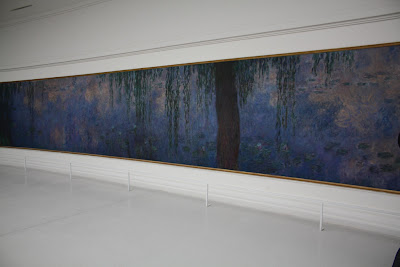
In Paris I got to complete the artistic circle and see a beautiful collection of Monet's garden paintings. Not far from the main part of the Louvre is the Musee de l'Orangerie, which was the old orangery for the Tuileries Palace. This building was converted into an especially designed showcase for a series of Monet's paintings known as the Nympeas (the genus of water lilies). The main floor of the museum is divided into two large oval rooms, each featuring four paintings which wrap around the rooms. The more cerebral setting of the museum really changes one's impression of Monet's garden. It becomes more about the idea of a garden, rather than a specific physical place.
But even in this rarefied environment you'll find a distracting tourist striving to get the perfect shot (Hi mom!)
I'm a landscape architect in Williamsburg, Virginia. I'm a graduate of the University of Virginia and currently employed with Hertzler & George. I'm also President of the John Clayton Chapter of the Virgina Native Plant Society.
-Phillip Merritt

 For the last in my series on the European gardens I visited this past May, I'd like to take you on a quick tour of Villandry, a beautiful castle and garden located on the south side of the Loire River. I call this the most surprising because, although I was vaguely familiar with it, I was not prepared for what I was about to see. In the back of my mind, I recalled some images that I had seen in landscape history class of French chateaux and gardens. These drawings, sketched by architectual designer Jacques I Androuet du Cerceau were done in the 16th century.
 Based on these engravings I was expecting an elegant, but cold garden, divided into flat, fussy, parterres (c'mon, isn't that what you think about French gardens?). How wrong could I be! Yes, it has immaculate parterres, but nothing like I had expected.
 The garden is probably most famous for its vegetable garden, with its edging clipped to an unearthly precision. But I was surprised but the intense color of the flowers and even the vegetables. It was almost like being on an acid trip!
 Large masses of cabbages and lettuce gave the veggie garden a nice variety of color and texture.
 Most of the castle dates from dates from the Renaissance, though it was built on the grounds of a 14th century keep. It's not hard to make out the older tower below from the "newer" parts of the building (The tower provides an excellent spot for viewing the intricate design of the garden). In 1906 the rundown building was purchased by Joachim Carvallo, a Spanish doctor, who created the present gardens. He was partly inspired by the sketches of Andruet du Cerceau that I mentioned earlier but wasn't afraid to use his own ideas in the design.
 The beautiful sketch below is from the official Villandry website (I hope they don't sue me for using it!). If you notice in the plan the layout is a mix of asymmetric medieval design and Renaissance geometry. This is what I especially like about this garden. It's not a strict reconstruction of a historic garden; it spans a wide range of eras, right up to the present.
 The garden is devided into sections defined by a changes in elevation. The potager, or kitchen garden, is on one level; the love garden and music garden are above that; the water garden is above them; and the sun garden is at the highest level. These changes in elevation feel very different from how they look from above. From the top of the tower, the garden looks sort of flat, but only because the garden is so large. Walking through the garden, you experience a great variety of spatial definition.
 The garden is also divided by canals which run through the property. The water ways have beautifully detailed stonework and were dotted with red valerian growing along the canal walls when I visited.
 So wandering up from the veggie garden, you'll find the love garden and the music garden, which get their names for the motifs used for the hedge patterns. While not as colorful as the vegetable garden, it's still fascinating to wander through the music garden paths (the love garden is cordoned off).
 These hedges are similar to a maze (of course the garden has one of those too). It was very peaceful wandering through them.
 Near the top of the garden is the water parterre, designed in the shape of a Louix XV mirror. A geat spot for reflecting on the reflections!
 And beside the water parterre, at the top of the garden, is the newest addition - the sun garden (it was great to see that new spaces are still being added). One part of the sun garden features an English style garden with the arbitrarily meandering paths typical of English landscape design It's filled with cool colored plants like violet catmints, white dicentra, and the blue-violet delphinium below.
 Next to that is another garden with radial paths emanating from a star-shaped fountain.
 It featured lots of bright warm plants like orange poppies (below), yellow daylilies, and red columbine.
 The picture of the bed below doesn't quite capture the intensity of the colors.
 It's kind of sad that while I was looking over the garden plan for this article, I started to see all sorts of other spaces that I never even got to see. I could easily have spent most of a day there. And I'll probably never be back there - there so many other places to visit before I can I can start to do repeats.